
The Smart Guide to the Real Cost of Running Separate Business Tools
The cost of business software tools uk is not only the subscription line on a bank statement. It is the time spent moving a customer’s name from one place to another, checking which calendar is correct, chasing a message that lives in the wrong inbox and trying to explain why a payment, order or booking is missing. Small businesses rarely choose eight systems on purpose. They collect them one useful fix at a time.
Contents
Why the cost of business software tools uk is bigger than the monthly bill
One tool helps with bookings. Another takes payments. A third holds customer notes. A fourth sends messages. None is necessarily a bad choice in isolation. The trouble starts when every tool needs the same information entered separately and nobody is certain which version is the live one.
The result is a hidden workload: copying, checking, exporting, reconciling and apologising. That is the real cost of business software tools uk for a growing business. It affects the owner’s focus, staff confidence and the experience a customer receives.
The eight places work commonly gets split
- Customer enquiries and inboxes
- Bookings or appointments
- Sales follow-up
- Card payments and invoices
- EPOS and order activity
- Website forms and online requests
- Marketing lists and messages
- Reporting, tasks and internal notes
You may not use all eight. You may use more. The point is to map the real journey from first enquiry to repeat customer before deciding that one more app will solve the problem.

Where fragmented tools create customer friction
The customer has to repeat themselves
Someone who asks a question through the website should not have to repeat every detail when they call. Someone who books should not receive a follow-up that ignores the booking. When systems are separate, staff often fill the gaps manually.
The team works from different versions
One person trusts the diary. Another trusts the spreadsheet. A third has the latest message in their phone. This is a process problem, not a people problem.
Reporting comes too late to help
If you need a Friday afternoon export to understand Monday’s enquiry volume, you cannot respond quickly. The cost of business software tools uk includes decisions delayed because the information is not together.
A practical way to audit your current stack
Spend one hour tracing a single customer journey. Start with a real enquiry and write down every tool that is touched before that person becomes a customer. Then ask four questions at each handover: what information is entered, where it came from, who needs it next, and what happens if it is wrong, late or missing.
This makes the cost of business software tools uk visible without guessing. It stops you judging a system only by its feature list. The right platform is the one that removes meaningful duplicate work in your actual process.
One connected platform versus a collection of tools
| Question | Separate tools | Connected platform |
|---|---|---|
| Customer record | May be copied between systems | One agreed record |
| Team handover | Often relies on notes and memory | Shared process and visibility |
| Follow-up | Can be missed when an inbox is busy | Planned from the customer journey |
| Reporting | Needs manual comparison | Reviewed in one place |
A connected platform is not automatically right for every business. Some specialist tools need to stay. The aim is not to force everything into one screen; it is to reduce the handoffs that cost time and create errors.

What should stay separate?
Keep a specialist system when it has a clear job, the team uses it well and it connects cleanly with the rest of your operation. A regulated accounting process may need its own controls. A specialised kitchen, stock or industry system may be the best operational tool.
The warning sign is not “we use more than one tool.” It is “we manually retype the same information because the systems do not speak to each other.” That is where the cost of business software tools uk turns into a daily drain.
How First Essential One can simplify the core journey
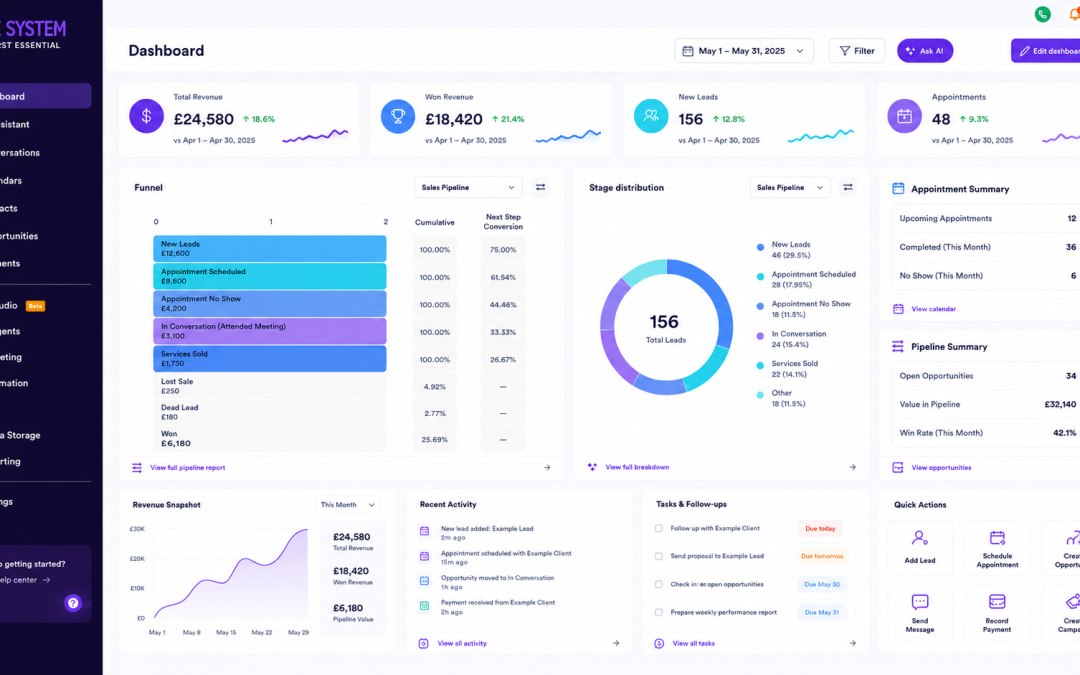
First Essential One is the platform we configure around the parts of your business that need to work together: enquiries, customer records, follow-up and day-to-day visibility. It works best when it is built around your team’s actual process, not an idealised diagram.
It can sit alongside your EPOS, payment setup, website, AI assistant workflows, kiosk system and multi-site process.
Security, permissions and ownership
Bringing processes together should not mean giving everyone access to everything. Decide who can see customer information, who can change bookings, who can issue refunds and who owns each workflow. The ICO’s AI and data protection guidance, the NCSC guide, PCI merchant resources, and FCA payment guidance are useful starting points.
How to plan a low-disruption rollout
Do not change every workflow in one week. Start with the journey where duplicate work causes the most problems, agree the new process, test it with the people who will use it and set a clear owner for each step. Keep the old process available until the new one is proven on real work.
That turns the cost of business software tools uk into a decision framework. You are not buying technology for its own sake; you are removing a specific source of friction.

The time cost nobody puts on a software invoice
When information moves between separate tools, someone becomes the integration. Usually it is the owner or the most reliable member of staff. They copy a name from an enquiry form to a diary, compare a payment with a booking, paste an order note into a group chat and chase an update before the customer calls again.
None of these actions looks dramatic on its own. The cost of business software tools uk appears when they happen dozens of times a day. The business loses focus, staff rely on memory and customers receive different answers depending on who picked up the message.
Write down the repeated actions that only one person knows how to do. They are often the best place to simplify first. A good process lets a colleague see what has happened without asking for a screenshot or searching through several inboxes.
Look for duplicated data before replacing a system
Do not start with a supplier comparison. Start with the customer record. Where is the name first captured? Which system holds the contact details? Where are booking notes, payment status and follow-up recorded? If the same detail is entered in two or three places, decide which record should be the source of truth.
That question avoids a common mistake: moving to another collection of tools without changing the process. The cost of business software tools uk remains because staff still have to move data between them. A connected process should reduce steps, not add a new dashboard for its own sake.
Give every handover an owner
Every step from enquiry to repeat business needs a clear owner. One person or team owns new enquiries. Someone owns booking changes. Someone owns a failed payment or a delivery issue. The task may be shared, but the responsibility must be visible.
When ownership is unclear, the customer feels the gap first. They receive no reply, are asked to explain again or turn up to find that the booking was never passed on. Joining up systems helps, but it cannot replace a process that nobody owns.
Common signs the stack is holding you back
- Staff maintain side spreadsheets because the main system is hard to trust.
- Customers are contacted twice because lists are not joined up.
- Bookings, orders or leads disappear when a person is absent.
- Reports require manual exports before a simple question can be answered.
- The business cannot see the journey from first enquiry to completed sale.
- A new tool is bought to solve a problem created by the previous tools not connecting.
These signs do not mean you must change everything. They mean the cost of business software tools uk should be measured against a clear operational problem before you add anything new.
Choose the first workflow carefully
Pick a workflow that is frequent, visible to customers and painful when it fails. For a salon this could be an enquiry becoming a booking and then a reminder. For a trades business it could be a website request becoming a scheduled visit. For hospitality it could be a call, order, payment and customer follow-up.
Define the successful outcome in plain English. For example: “every new enquiry has an owner and a next step by the end of the day.” This gives the team something real to test. It also makes it easier to tell whether the new process is better than the old one.
Build around the people who use the process
Ask staff what they have to remember because the current system does not show it. Ask them which information they need most often and where they waste time. This is not resistance to technology; it is evidence about the real job the process must do.
Involve the people who answer the phone, manage the counter, book appointments or follow up leads. They will spot a missing handover much earlier than anyone looking only at a software demonstration.
Set a realistic migration plan
Before moving customer information, decide what needs to come across, what can be archived and what must be checked by a person. Remove obvious duplicates where it is safe to do so. Keep a record of the old system until you have proved the new process on genuine enquiries, bookings or orders.
Train the team on the new process, not only the buttons. A screen walkthrough is not enough if they do not know what to do when a customer changes their mind, an order is incomplete or a message arrives outside normal hours.
Measure the result in customer terms
Review response time, missed follow-ups, duplicate records and the time it takes to find a customer’s status. Then ask whether customers have fewer reasons to repeat themselves. A small improvement in one high-volume workflow can be more valuable than a large feature list.
Used this way, the cost of business software tools uk becomes an honest decision tool. You can see which complexity is necessary, which complexity is avoidable and where a joined-up system would genuinely make the business easier to run.
Before you buy another tool, ask these questions
A new app can look like a quick answer because it solves one visible frustration. Before committing, ask where the information will start, where it will end and who will keep it current. Ask whether the tool creates another separate customer record or improves the record your team already relies on.
Also ask what happens when someone leaves, when a customer changes their details, when an order is cancelled or when a message arrives outside usual hours. Those are the moments when an attractive feature list meets daily operations. If the answer is “we will work it out manually”, you may be adding to the cost of business software tools uk rather than reducing it.
Finally, agree the decision maker and the day-to-day owner before any change begins. The person who signs a subscription may not be the person who discovers the consequences at a busy counter or in a full diary.
When a single platform is not the answer
There are times when keeping separate systems is the right choice. A business may have a sector-specific tool that handles an important workflow well. It may have an accounting system with controls that should remain independent. It may be testing a new service and need a lightweight process before building a fuller connection.
The goal is not to remove every tool. The goal is to make the route between them clear, avoid duplicate data and give staff one dependable way to see the customer’s next step. A sensible platform strategy is selective: connect what creates friction, leave specialist tools alone when they work, and review the process as the business changes.
Make the customer record useful to the whole team
A useful customer record shows the information a colleague needs to help without opening several tabs: contact details, the latest enquiry or order, important notes, the agreed next step and the person responsible. It should not become a dumping ground for every possible detail.
Agree what is essential, who updates it and when it is reviewed. A short, trusted record is more valuable than a large database people avoid. This is one of the clearest ways to reduce the cost of business software tools uk: less searching, fewer assumptions and a more consistent answer for the customer.
Key takeaways
- The cost of business software tools uk includes time, errors and delayed decisions, not just subscriptions.
- Map one real customer journey before replacing anything.
- Keep specialist systems where they add value; remove pointless copying between systems.
- Introduce one joined-up process at a time and measure whether it reduces friction.
Frequently asked questions about cost of business software tools uk
How many business tools is too many?
There is no fixed number. You have too many when staff repeatedly copy the same customer information or cannot tell which system is correct.
Should a small business put everything in one platform?
No. Keep specialist systems that do an important job well. Focus on connecting the customer journey and reducing duplicated work.
Can First Essential One replace every system we use?
It should be planned around your process. We would review current tools and identify which parts should connect, remain separate or be simplified.
Does connecting systems make data less secure?
Not if it is planned properly. Access controls, clear ownership and sensible data handling are part of the setup.
How do I calculate the cost of business software tools uk?
Track subscription costs alongside time spent rekeying information, chasing updates and correcting mistakes across a normal week.
Ready to simplify the way your business runs?
We can map one customer journey with you and identify the first practical place to join it up.